Your Risk Management Is a Lie: Why Everything YouTube Taught You Is Wrong
Quant Trading
A former markets desk trader (Societe Generale, HSBC, Lyxor) breaks down why the standard retail risk management playbook, the 2 percent per trade rule, the fixed R sizing, the stop loss as a safety net, is built on a Bernoulli model that never holds on real markets. Covers why win rate is not stationary, why sizing without volatility is meaningless, why a stop loss is not an execution guarantee, why leverage should never be a function of stop distance, and how institutional desks actually separate the trader role from the risk manager role.
Antoine
CEO - CodeMarketLabs
2026-09-11
The trading advice you get online always sounds like the same recipe. Risk 2 percent of your account per trade, define your R, place your stop loss where your thesis gets invalidated, stay disciplined, manage your psychology. I spent several years on a markets desk, in portfolio management and trading, and in this piece I am going to take apart these concepts one by one. Before even touching sizing or stop losses, there is a mental model underneath all of it that is simply wrong, and everything else inherits that error.
What this article covers
Why treating trading as a Bernoulli experiment (a fixed win probability repeated independently) does not hold on real markets.
Why your win rate and your edge are never stationary, they appear and disappear with market regimes.
Why sizing a fixed percent or a fixed dollar R without accounting for volatility makes no sense across asset classes.
Why a stop loss is a price level, not an execution guarantee, and what a gap does to that assumption.
Why leverage should never be a function of stop distance alone.
Why drawdown is a risk metric, not a psychological event, and how institutions structurally separate the trader from the risk manager.
1. The Hidden Error: Trading Is Not a Bernoulli Trial
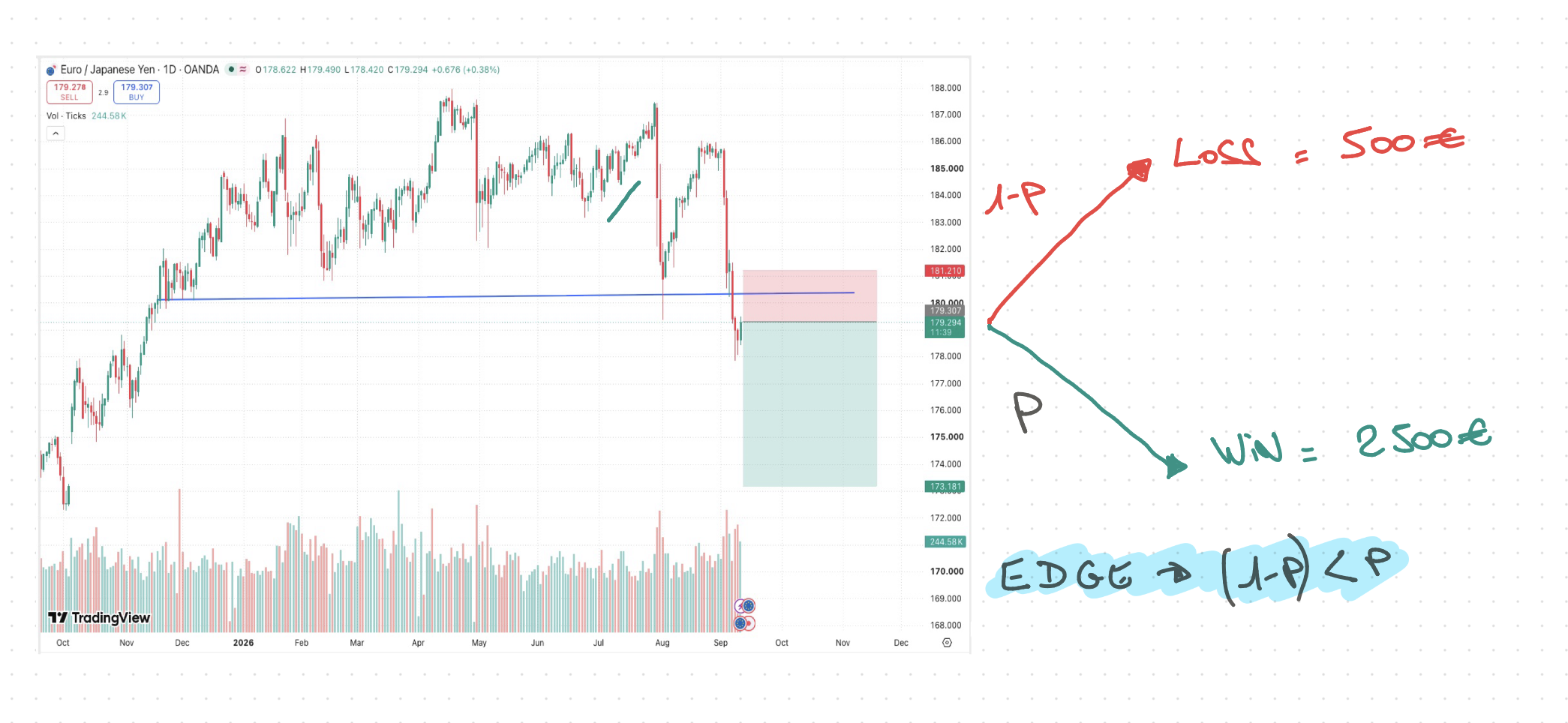
No trading educator ever says this part out loud, but it sits underneath every single rule you have been given: the 2 percent per trade, the fixed stop loss, the win rate math. All of it treats trading as a simplified binary experiment. You either win or you lose. You have a probability of winning and a probability of losing. That is literally a repeated Bernoulli trial. On top of that, you are told that if you have an edge, your probability of winning is higher than your probability of losing, and that your average win is two or three times your risk while your average loss is exactly one times your risk, because your stop loss sits in the right place.
schema-bernoulli
This model is not mathematically false in itself, but it only holds if two conditions are met. First, every trade outcome has to be fully independent of the others. Second, the distribution has to stay constant over time, what finance calls stationarity. Neither condition is ever actually met. Your probability of winning or losing on a given setup evolves constantly. Edges are not constant, they appear and disappear depending on market regime, on other participants finding and then arbitraging away the same inefficiency, on structural shifts you cannot see in real time. If your stats really behaved like the clean diagram above, making money would be trivial. And the independence assumption fails just as badly, because your trades will always share some correlation through macro variables, geopolitical events, or simply the fact that correlated assets move together. Treating trading and risk management as a rigged coin flip in your favor is the first error, and it is the one that undermines every downstream rule about win rate and stop loss you will ever be taught.
2. Sizing Without Volatility Is Not Risk Management
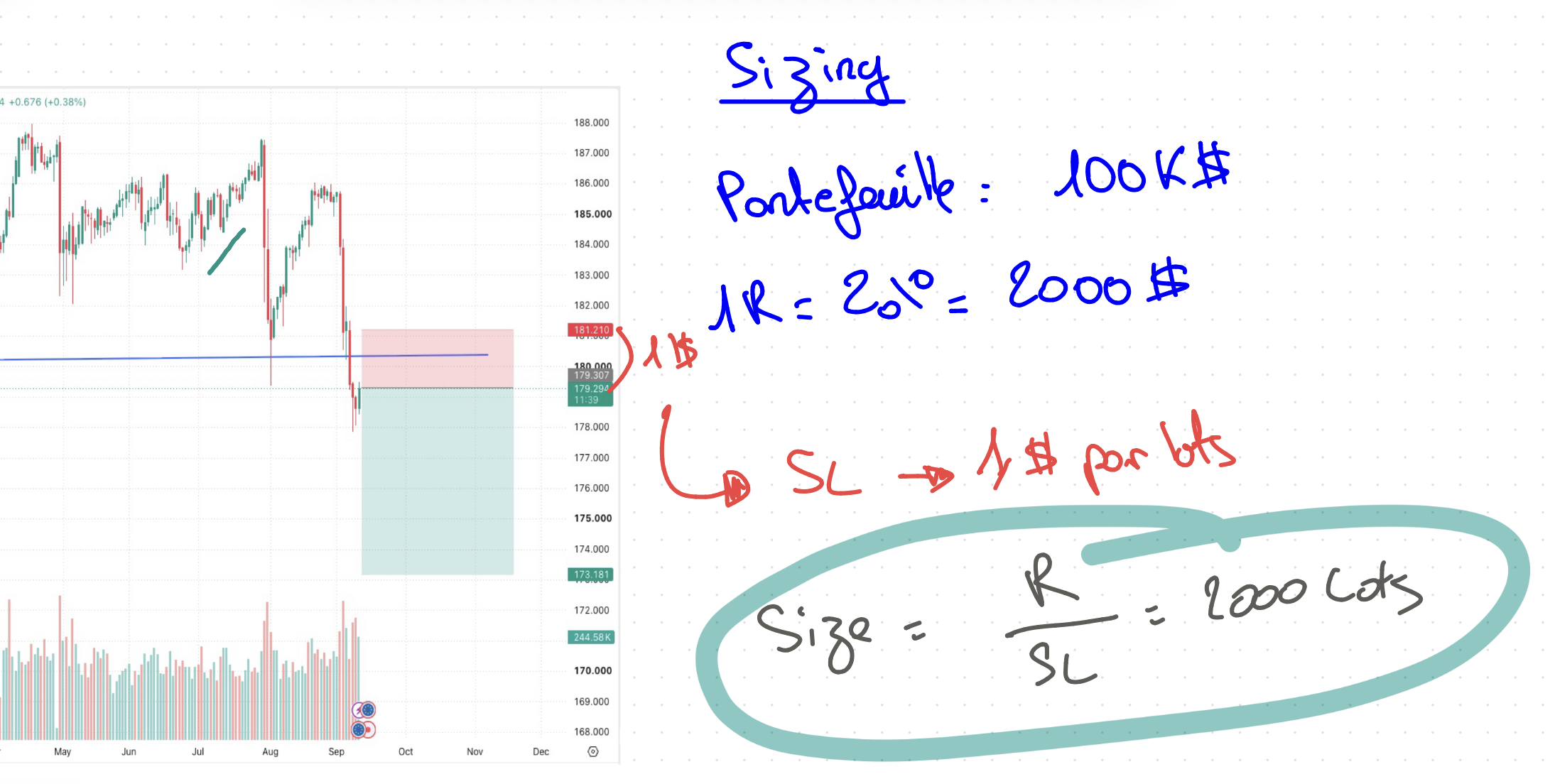
The second widespread mistake is position sizing that ignores volatility entirely. Saying 2 percent of my book goes on this position, or my R is 2000 dollars on this trade, treats every asset as interchangeable. It is not. Every asset class has its own volatility profile, and even within a class there are huge differences. EUR/USD is not remotely as volatile as USD/BRL. The typical workflow looks like this: size 2 percent of the portfolio, place the stop loss where the thesis is actually invalidated, then divide the dollar risk by the stop distance to get position size. That sounds fine until you realize what it actually implies: putting the same dollar risk on a bond and on the S&P 500 as if they behaved the same way, when one might carry 5 percent annualized volatility and the other 17 percent.
schema-sizing
Take Bitcoin at roughly 60 percent annualized volatility, that translates into an average daily move of about 3 percent. Size it like a low volatility instrument and your stop loss gets hit constantly, the sizing has no real relationship to the asset's actual behavior. Do the same on a low volatility instrument and the stop loss becomes irrelevant because it will basically never trigger. The only variable that matters in risk is which quantity is actually moving, not a flat dollar figure attached to an arbitrary stop. The reason this simplified version gets sold everywhere is that it is easy to teach: a clean max loss number, a clean win number, no standard deviation, no distributional thinking required. Easy to sell does not mean it works.
3. The Stop Loss Was Never a Guarantee
The third false assumption is that a stop loss will actually be executed at the price you set. If equities gap at the open, or a currency gets depegged overnight, your stop loss is not filled where you placed it, it is filled wherever the market reopens. What you thought was a controlled 1000 dollar loss because of your leverage and your binary win-loss framework can turn into a 20000 dollar loss that liquidates the account, simply because the market moved through your level on a gap with no continuous liquidity in between. All of this retail risk management logic implicitly assumes a world with no correlation between asset classes, no correlation between instruments within a class, and continuous, gap-free markets where your stop is always filled exactly where you placed it. None of those assumptions hold, which is precisely why the framework performs so poorly when it matters most.
4. Leverage Should Never Be a Function of Stop Distance
Under this retail approach, your leverage on a given trade depends on exactly one thing: the distance to your stop loss. The tighter the stop, the bigger the notional. The wider the stop, the smaller the notional. That means the closer your stop sits to price, the more likely it is to get hit, and yet that is precisely when you are taking on the most leverage. It also means that on your best trade, the one with real statistical merit but a wide invalidation level, you end up barely levered at all, while on a mediocre setup with a tight stop you can lever up aggressively, exactly when the probability of being wrong is higher. Sizing that actually accounts for volatility and other statistical variables produces a max leverage per asset, a max leverage per instrument, and a max leverage for the book as a whole, none of which come from stop distance alone.
5. Drawdown Is a Risk Metric, Not a Feeling
The fourth widespread distortion online is drawdown treated as a psychological milestone in a trader's journey. You are told a drawdown is emotionally hard, that you should pause trading, that markets are simply unpredictable sometimes. That framing misses the point entirely. Drawdown is a risk metric. It is the maximum historical loss of a portfolio, or of a strategy backtest, and it typically breaks down into two statistics: the maximum drawdown itself, and the time to recover from it. Once drawdown crosses certain thresholds, 5, 10, 15 percent, it should trigger concrete decisions about future positioning, not a mood. Proprietary trading firms liquidate accounts at fixed drawdown levels precisely because it is a hard risk boundary, not because someone needs a mental health break.
6. How Institutions Actually Manage Risk
At an institution, as a trader or portfolio manager, you operate under a mandate that spells out hard limits: maximum leverage, permitted instruments, maximum value at risk, sometimes a target annualized volatility band of 10, 15, or 20 percent. That mandate is built and enforced by a separate quantitative risk team whose job is to control the trading desk's operations. The trader's job is simple in principle: make money within the limits of that mandate. There is no psychology angle here, only whether you are inside the framework or not. Structurally, the trader is optimistic about their own positions, because they built the thesis and would not have opened the trade otherwise. The risk manager's mandate is the exact opposite: the survival of the book, the desk, the firm. Their job is to stay constantly pessimistic, monitor every limit continuously, value at risk, drawdown thresholds, per-instrument and per-bucket exposure, and pull the trader back inside the boundaries the moment a limit is breached, regardless of how convinced the trader is. A trader never controls their own limits, and being both the risk manager and the trader on your own book, judging your own trades while holding the actual pen on risk, is a conflict of interest that would be considered untenable inside any real institution.
In practice this means separating the roles yourself: set your limits first, acting as the risk manager who defines the boundaries in advance. Then, separately, act as the middle office reviewing every trade already placed against those limits. Only then act as the trader generating and placing new ideas. It is harder alone than inside a structured desk, but the separation is the entire point. None of this is trading as repeated independent draws with known win and loss probabilities. A stop loss was never a guarantee. Leverage has to come from your risk limits, never from stop distance on a chart. Sizing has to differ by asset and by asset class, never a flat 2000 dollars or 2 percent of the book. Drawdown is a risk metric, not an anecdote. And no one is psychologically equipped to be both their own trader and their own risk guardrail, reliably, over time.
Does this mean the 2 percent rule is always wrong?
Not always wrong in isolation, but incomplete on its own. A fixed percent per trade ignores the volatility of the specific asset, the correlation with other open positions, and whether your edge is even stationary right now. It can be a starting point, never the whole framework.
If stop losses are not guarantees, should I stop using them?
No, a stop loss is still a useful invalidation level for your thesis and for automated execution most of the time. The point is not to treat it as a hard ceiling on your loss, especially through gaps or illiquid conditions, and to size your position with that gap risk in mind.
How do I size for volatility without a whole quant team?
At a minimum, scale your position size inversely to the asset's recent realized or annualized volatility instead of using a flat dollar or percent figure. The next video in this series covers a practical, institutional-grade way to do this.
Can a solo trader really separate the trader and risk manager roles?
Yes, but it has to be deliberate. Define your risk limits and sizing rules before you have any position on, review your existing trades against those limits on a fixed schedule, and only then look for new setups. Doing all three at once, in the moment, is where the conflict of interest creeps back in.
Why do prop firms liquidate accounts at a fixed drawdown percentage?
Because drawdown is treated as a hard risk boundary, not a mood to manage through. Once a portfolio or a trader crosses a defined maximum drawdown, the statistical case for continuing to trade the same way has usually already broken down.