I Borrow Against My Portfolio Without Selling a Single Share (The Box Trade)
Quant Trading
How to borrow cash on the financial markets without touching your portfolio, using a four-leg options structure called the box trade. Covers strike selection, execution on Interactive Broker, how to calculate your real implied borrowing rate with a free Excel calculator, and the concrete situations where this Lombard-loan alternative actually makes sense.
Antoine
CEO - CodeMarketLabs
2026-10-02
I've been trading, investing and building businesses for years, and I keep running into the same wall: access to capital. A new project, a down payment, a new algo strategy to deploy, it always comes back to cash. The usual fix, selling part of your portfolio, is expensive: you pay capital gains tax and you give up the 8 to 12% a year that capital could keep earning you. When I worked in private banking, my wealthy clients had a way around this. They handed their assets to a manager (me) and got credit worth up to 50 to 60% of what they had on deposit. That's a Lombard loan. The problem is if you're building your wealth with 50k, 100k, or 200k, you don't get access to it. So here's how to borrow on the financial markets and place your capital there, market-neutral, in euros, dollars or any other currency, with nothing but an Interactive Brokers account, an options strategy anyone can learn, and at least 20 to 30k of capital. That strategy is the box trade.
What this article covers
What a box trade is: a four-leg options combination that locks in a borrowing or lending rate close to the market's risk-free rate.
How to pick your strikes and contract, SX5E for euros or ES futures for dollars, based on how much you want to borrow.
How to build and execute the trade step by step on Interactive Broker, and why the exercise type matters.
How to calculate your real implied borrowing rate with a free Excel calculator, and judge whether your price is competitive.
Four concrete situations where a box trade beats selling your portfolio, and three where you should never use it.
The three real risks: exercise type, liquidity, and refinancing rate risk.
1. What a Box Trade Is, and Why It Replaces a Lombard Loan
A box trade is a combination of two puts and two calls. You sell them if you want to borrow money on the financial markets, and you buy them if you want to place capital there instead. Because of how option pricing works under Black-Scholes (I'll do a dedicated video on that if there's interest), this four-leg combination locks in a result that's a gain or a loss almost exactly equal to the market's risk-free rate. In other words, you've built a synthetic loan or deposit entirely out of options.
The first step is choosing your strikes, and that depends on the contract you trade. In euros, you use the SX5E index (Eurostoxx 50). In dollars, you use the ES future on the S&P 500 via Interactive Broker. The SX5E contract has a 10-point multiplier, the ES future has a 50-point multiplier, and that multiplier is what turns a point spread between your two strikes into an actual dollar amount you're borrowing or lending.
2. Choosing Strikes and Building the Structure
Say you want to borrow $20,000. To pick your strikes, you divide that amount by the contract's multiplier: $20,000 divided by 50 points gives you a 400-point spread between K1 and K2. In this example, K1 sits at 7,750 and K2 at 8,150 on the ES contract. Once you've fixed those two strikes, the structure comes together in two steps.
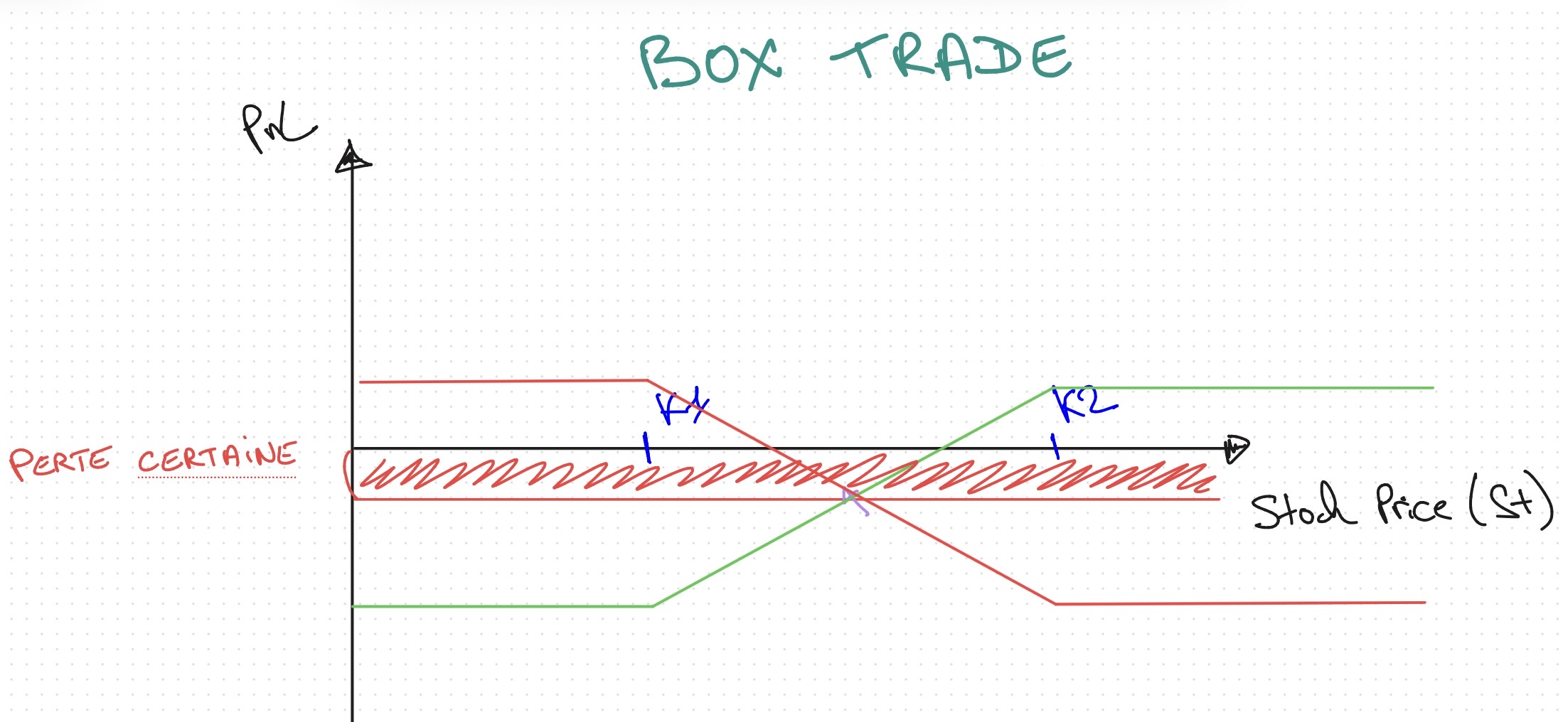
Step one is a call spread: you sell a call at K1 (you collect a premium, call it P1) and buy a call at K2 (you pay a premium, P2). Step two mirrors that with a put spread in the opposite direction: buy a put at K1, sell a put at K2. Combine the two spreads and the payoff lines cross at a single negative value, that crossing point is the final price of your loan.
box-trade-payoff-diagram
3. Executing the Box Trade on Interactive Broker
Open the option chain for your contract, pick the expiration you want to borrow against (roughly a year out gives you a clean annualized rate), then right-click and check the description to confirm you're looking at European-style options. This step is not optional. Regular monthly options on an index like the S&P are often American-style, while the weeklies are typically European. A European option can only be exercised on its very last trading day, so all four legs of your box trade expire together and market risk disappears. An American option can be called by the buyer at any point before expiration, and that alone can unbalance your entire structure.
Once you've confirmed European exercise, check the strategy builder box, sell the legs you're meant to sell, buy the ones you're meant to buy, and submit the order. On a $20,000 target, you'll typically see something like a $19,100 credit hit your account immediately, with the position converging toward the full $20,000 obligation as the trade approaches maturity. Setup costs, mostly commissions, run somewhere around $50 to $60.
4. Calculating Your Real Implied Borrowing Rate
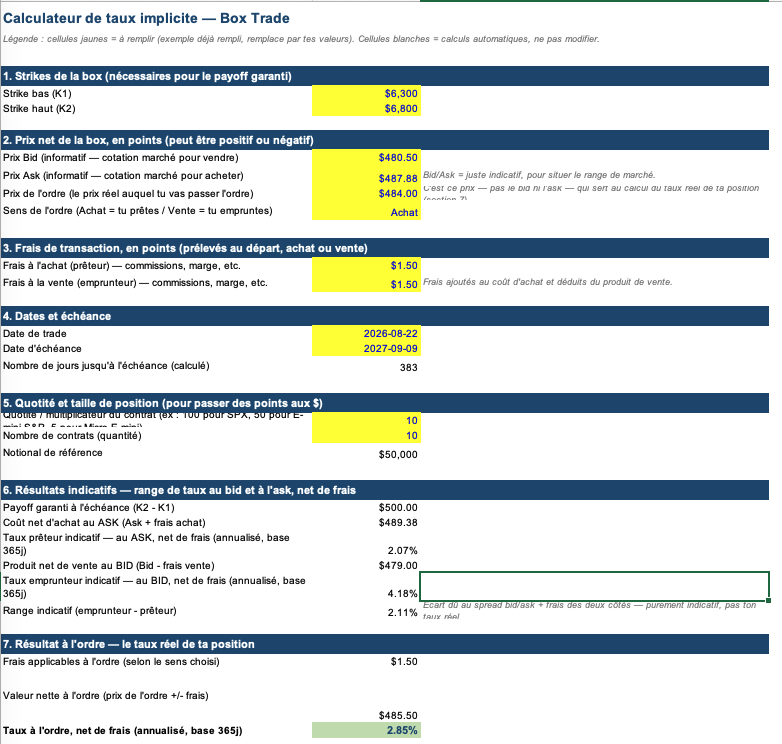
Knowing you got a $19,100 credit for a $20,000 obligation doesn't tell you if that's a good rate. That's what the free Excel calculator I built is for. You feed it your two strikes, the option prices at the bid and the ask, your commissions, the trade date, and the maturity date, and it hands back three numbers: the rate you're borrowing at if you trade at the ask, the rate at the bid, and the rate at the mid, plus the bid-ask spread itself, which in this example ran around 160 basis points, worth roughly $1,600 on a $100,000 notional.
That spread tells you something important: quoting right at the mid usually means nobody takes your price immediately, you're leaving 80 or so basis points of edge on the table for whoever fills you. The more patient you are, the closer to the mid you'll get filled; the more urgency you have, the worse end of the spread you'll pay. To judge whether your price is actually good, pull up the interest rate curve the option chain shows you for that maturity. In this example, the market curve sat around 4.44% while the quote was 4.67%, only about 20 basis points above the market, a solid price worth being patient for.
box-trade-implied-rate-excel-calculator
5. Four Reasons to Actually Use a Box Trade
The first is financing a project under a year, for less than 30% of your portfolio's value, when you want to keep your assets intact. Fund the project with this debt, repay it within a year from whatever cash comes in, and don't sell assets earning you 6 to 12% a year just to cover a short-term need.
The second is segregating accounts. I run a large financial portfolio alongside several smaller options and algo trading strategies, and I don't want to sell my long-term core holdings to fund 10, 20, 30, or 40 thousand dollars for one of those strategies. So I run a box trade in the main account, move the capital into a separate, segregated Interactive Brokers account, run the strategy there, and repay the capital or not depending on how it goes.
The third is a sharp market downturn. I've done this twice, in 2020 and in 2022. When markets fall, my portfolio loses value and I have no cash left to add to positions. So I'll borrow 20, 30, or up to 40% of the portfolio after the drop and reinvest it across my holdings. On the way back up, I either roll the box trade forward or simply repay it. It's kept me calm and let me keep buying through the recovery.
The fourth is financing something your bank won't touch. Say you have a million euros on Interactive Broker, you're an expat, and you want to buy a 50 or 60 thousand euro apartment abroad, in a currency that isn't your own. Your bank won't lend against a million euros of securities for that. A box trade for 60,000 euros represents only 5 to 10% of your portfolio, gets repaid from a few years of dividends, and can be rolled forward if needed.
6. When Not to Use It, and the Three Real Risks
There are cases where you should never do this. Don't use a box trade to add leverage when markets are already expensive and you're convinced of something you actually have no real evidence for. Don't oversize it either: banks will lend up to 50 or 60% of a client's financial assets because they have risk models and trading desks backing them up, you don't, so cap yourself at 20 to 25% of your portfolio, which is already a solid amount. And don't ever use a box trade to fund groceries or lifestyle spending, that's simply not what it's built for.
The first real risk is exercise type. As covered above, you must confirm you're trading European-style options. If you're exercised early on an American option, your four legs desynchronize instantly and you're exposed to real market risk you thought you'd eliminated.
The second is liquidity. Getting into a box trade at a good price is one thing, being able to exit it when you need to is another. In a volatility spike or a sharp market selloff, spreads widen and you may not be able to close the position at a reasonable price. Stay patient, and again, size the trade to a share of your portfolio you're genuinely comfortable holding through a rough patch, no more than 20 to 25%.
The third is rate risk. A box trade is a fixed-term loan. If it matures in three months and you don't have the cash to repay it, you'll need to refinance, and rates by then could be higher, lower, or unchanged, you simply don't know. Measure that risk, lean into the strategy more when rates look attractive relative to where you expect them to go, and have a real decision process for handling it rather than assuming today's rate will still be there at maturity.
Can I do a box trade in euros instead of dollars?
Yes, use SX5E futures (Eurostoxx 50) instead of ES, with a 10-point multiplier instead of 50. Everything else about strike selection and execution stays the same.
What happens if I accidentally use American-style options?
You risk early exercise by the counterparty, which desynchronizes your four legs instantly. Always confirm exercise type via right-click, then description, before you trade.
How much of my portfolio should I borrow through a box trade?
Cap it around 20 to 25%. You don't have a bank's risk models or trading desk behind you, so size conservatively even though banks lend up to 50 or 60% against the same collateral.
What if I can't repay the box trade when it matures?
You'll need to refinance, by rolling into a new box trade or another loan, at whatever rate the market offers at that time. That's the core rate risk of the strategy.
Is a box trade a good way to fund everyday spending?
No, it's built for time-bound projects or opportunities you can repay within about a year, not for lifestyle or recurring expenses.
How do I know if the rate I'm being quoted is good?
Compare it to the market's own risk-free curve for the same maturity, visible in the option chain's interest rate view, and use the calculator to see your rate at the bid, ask, and mid before you commit.