How to Invest in the Stock Market in 2026: The Complete Method From a Former Portfolio Manager
Finance & Macro
A former trader and portfolio manager at Société Générale's private bank breaks down the exact process used in institutions to build an investment portfolio: passive vs active management, top-down vs bottom-up approaches, a full asset class overview, how to set your risk level using the efficient frontier, and how to actually pick your holdings. Everything you need to go from zero to a coherent, diversified allocation, without needing to be a finance genius.
Antoine
CEO - CodeMarketLabs
2026-09-04
It's 2026, and one thing is certain: building wealth today almost always means going through the stock market, whether in equities, bonds, funds, or ETFs. The problem is that most people never got any financial education. It scares them, it stresses them out, and they've been told since childhood that investing in the stock market is basically gambling. As a result, they hand their savings over to the state, to advisors, or to financial products that go nowhere. I spent 8 years in market finance, first as a trader, then as a portfolio manager at Société Générale's private bank. In this article, I'm giving you, from A to Z, the exact method used in institutions to manage a portfolio effectively, without overcomplicating things, at a risk level that actually fits you.
What this article covers
The difference between passive and active portfolio management
The top-down and bottom-up approaches used in institutions
A full overview of asset classes (equities, bonds, commodities, crypto, cash)
How to determine your risk level using the efficient frontier
The most common diversification mistakes
Three sample allocations by risk profile, and how to select your ETFs, funds, or individual securities
1. Passive or Active Management: The First Choice
Passive management is the simplest method. Historically, equities return between 8% and 12% annually over the long run, while bonds return somewhere between 3% and 5% depending on the interest rate environment, with much lower risk. You build a portfolio that matches your risk appetite, you put your monthly savings into it via DCA (dollar cost averaging), and you let time do the work, without overthinking it.
Active management, on the other hand, requires you to make your own decisions: what to invest in, when, and why. It splits into several approaches. The first is active management using only ETFs, reallocating capital between sector or geographic baskets depending on the macro environment. The second, purer approach is picking individual securities one by one (stocks, bonds, physical gold, futures contracts). The third is a middle ground: a core ETF allocation, complemented by a sleeve of individual holdings to express personal convictions.
The reality is that most people who try active management don't outperform a simple ETF on the S&P 500, the Eurostoxx 50, or the MSCI World. A former boss of mine at the bank used to say: 'To beat the benchmark, you first have to build the benchmark.' My advice to beginners: start with passive ETF management matched to your target risk, and only move to stock picking once you develop a genuine interest in financial analysis.
2. Top-Down vs Bottom-Up: The Two Logics of Active Management
If you choose active management, there are two main families of strategy. The top-down approach starts with macroeconomics and geopolitics, then progressively narrows down: asset classes, countries, sectors, and finally company selection within each sector. It's a cone-shaped approach, moving from the general to the specific.
The bottom-up approach does the opposite, in the style of Warren Buffett: you start directly from the most profitable, best-performing company, without worrying upfront about the macro scenario or sector allocation. Once you've identified the best companies, you diversify across them and adjust weightings to stay roughly consistent with the world's sector breakdown. A 100% energy portfolio can perform well during certain periods of geopolitical tension, but a -30% shock in oil prices can kill it overnight.
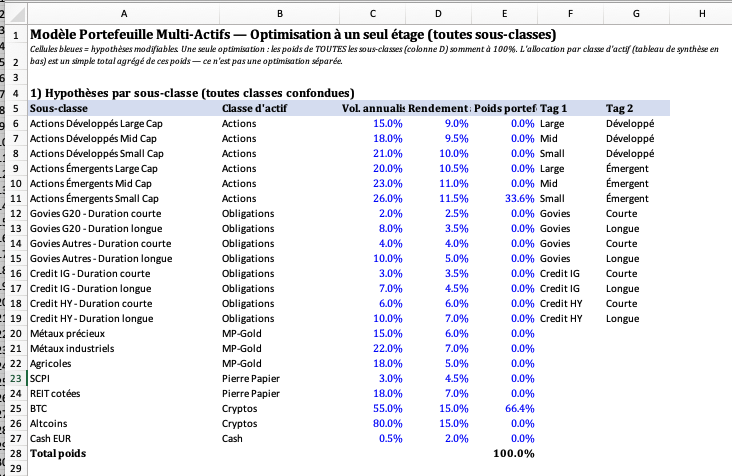
portfolio-optimizer-excel-allocation-result
3. The Asset Class Landscape
Equities represent a share of a company's capital: you earn dividends (your share of the profits) and capital gains if the share price appreciates. Within this asset class, risk increases from large-cap developed-market stocks (G10) down to emerging-market small caps. Overall, equities offer volatility of 17% to 20% for an expected return of 6% to 12%.
A bond represents a share of an issuer's debt: the company or government pays you an annual coupon and repays the principal at maturity. Bond prices move inversely to interest rates: when rates rise, prices fall, and vice versa. Issuers are split between investment grade (rated above BBB-) and high yield, which is riskier and therefore better compensated. Expect a return of 3% to 8% for volatility of 6% to 15%.
Next come commodities (agricultural, energy, precious metals like gold and silver), listed real estate (REITs and similar vehicles, which often behave like bonds but with more risk), cryptocurrencies (Bitcoin and altcoins, the most volatile asset class), and finally cash, which earns nothing but serves as dry powder to add to your positions when markets fall.
4. Setting Your Risk Level: The Efficient Frontier
To set your risk level, ask yourself a simple question: how much am I willing to see my portfolio move each year, up or down? On a €100,000 portfolio, are you comfortable with a €4,000 swing? A €20,000 swing? Your answer determines your target annualized volatility.
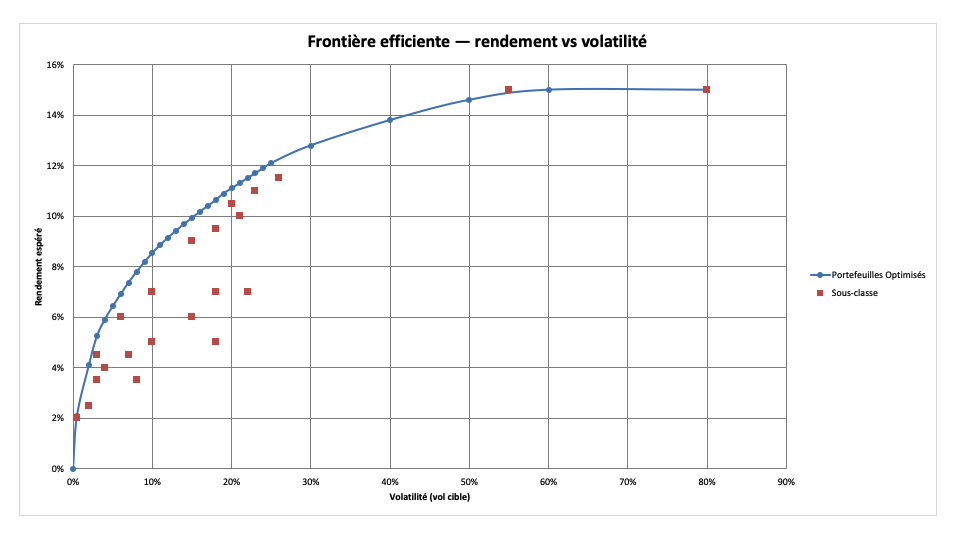
This concept relies on the efficient frontier, developed by American economist Harry Markowitz: for any given level of risk, there is an optimal allocation that maximizes expected return. The higher your target risk, the closer your portfolio moves toward the riskiest asset classes, in exchange for a higher expected return. Historically, the optimal portfolio sits around 20% annualized volatility for an expected return of roughly 10%.
efficient-frontier-chart
5. Diversification: Principles and the Most Common Mistakes
Diversification reduces long-term risk without giving up much return. A 100% altcoin portfolio shows roughly 80% volatility for a 15% expected return. Add a slice of cash, bonds, or equities, and risk drops to around 25%, while return stays between 8% and 10%. Diversification should span asset classes, geographies, sectors, and instruments.
Three mistakes come up over and over. First, believing you're diversified because you hold several ETFs (MSCI World, S&P 500, Nasdaq) when in reality you end up with over 80% US exposure and nearly 50% in tech. Second, home bias: investing only in companies you know near you. Third, believing you're diversified without understanding companies' real exposure: Nvidia (semiconductors) and Vistra (an electricity supplier) look uncorrelated, but Vistra powers data centers, so its stock largely tracks tech.
During a crash, correlations between companies tend toward 1: everything falls together. A poorly diversified portfolio with lots of positions can therefore end up worse, and more expensive in fees, than a concentrated portfolio of a few genuinely well-diversified holdings.
6. Three Sample Allocations by Risk Profile
To illustrate, here are three profiles built with a constrained optimizer (Bitcoin capped at 5%, gold and cash each capped at 10%), which you can find as a downloadable file linked in this article. Mireille, 85, wants to preserve her capital and pass it on. With a 4% volatility target, her optimal allocation comes out to roughly 14% large caps, 10% developed-market equities, 4% emerging-market equities, 40% government bonds, 15.9% investment-grade credit, a small high-yield sleeve, 3.3% gold, and 1% Bitcoin, for a final risk of 5.3%.
Thierry, 50-55 and still cautious, targets 6% to 6.5% volatility. His optimal allocation shifts toward roughly 30% equities and 52% aggregate bonds. At the other end, a savvy investor under 50, willing to accept 16% volatility, ends up with 91% equities, 3.4% long-duration bonds, and 5% crypto. Three profiles, three radically different allocations, all consistent with their target risk level.
7. Actually Selecting Your Holdings
If you're investing through ETFs or funds, start with your bank's available catalog. For ETFs, BlackRock (iShares) and Amundi (which absorbed the former Lyxor ETF range) are two solid references, one more US-oriented, the other more French. Fees stay contained, generally up to 0.50% per year on the more exotic asset classes. For funds, Morningstar's star rating is useful for comparing funds within the same category, especially for bonds, where ETF coverage is thinner.
If you're picking individual securities, you need a solid analysis tool: 20 to 30 years of history on valuations, ratios, and financial statements, a screener to filter stocks by your own criteria, and access to investment ideas. That's essentially what Mindstk, the software I helped co-found and use daily, provides, including AI-powered data access to quickly dig into a company. Other tools exist too, like Investing (less complete on fundamentals) or Simply Wall Street (more accessible but with less written analysis).
For bonds, data is harder to access. Trading Economics, World Government Bonds, or FRED (the St. Louis Fed) are good macro sources, but they require reprocessing. On credit risk, a broker like Interactive Brokers gives you access to ratings, rates, and duration; to go further, you'll need to analyze the issuer's debt level and debt-to-free-cash-flow ratio yourself, ideally with AI's help.
Do I have to choose between active and passive management, or can I combine both?
You can absolutely combine both: a passive core (diversified ETFs matched to your target risk) complemented by an active sleeve to express personal convictions on specific holdings. This is actually the most common approach among investors who gradually develop an interest in the markets.
How long does it take to master active management?
There's no fixed timeline: portfolio management is a deep discipline that takes years of practice in macro, sector, and fundamental analysis. Most retail investors don't beat a simple ETF, so it's best to start with passive management and only build up active skills if a genuine interest develops.
What exactly is the efficient frontier?
It's the curve that represents, for each level of risk, the allocation that maximizes expected return, based on Harry Markowitz's work. An asset sitting below this curve isn't efficient: there's another allocation that offers more return for the same risk.
Is it risky to hold several different ETFs?
Holding several ETFs doesn't guarantee diversification. A portfolio with an MSCI World, an S&P 500, and a Nasdaq ETF can end up with over 80% US exposure and nearly 50% in tech, which is far from diversified despite appearances.
How much Bitcoin or crypto should be in a diversified portfolio?
In the examples shown, the constraint used is a maximum of 5% Bitcoin, particularly for the most risk-averse profiles where the optimal allocation actually sits closer to 1%. More aggressive profiles can go up to that 5% cap.
How do I know if my portfolio is truly diversified?
You need to look at each holding's real underlying exposure, not just its sector label. Two seemingly different companies can be highly correlated if their revenue depends on the same economic driver, like tech for electricity suppliers powering data centers.