Your Euro Account Is Secretly Betting on the Dollar. Here Is How I Hedge It
Quant Trading
A euro investor holding US assets carries a EUR/USD position they never chose: about 12% of S&P 500 performance lost to FX in 2025 alone. I explain why unhedged currency risk adds about 40% of volatility to a market neutral portfolio, how FX futures are priced (carry, forward points, basis convergence), what a EUR/USD hedge really costs (about 1.4% per year today), and how to set up and roll a micro M6E hedge live on Interactive Brokers.
Antoine
CEO - CodeMarketLabs
2026-10-16
If you trade dollar assets from a euro account, you are carrying two positions: your strategy, and a EUR/USD position you never chose. On the S&P 500 alone, currency risk cost a euro investor around 12% of performance in 2025. Other years it paid back just as much. In both cases, you were not the one steering. I spent years as a portfolio manager and a trader, and carry, forward points and rolls were daily routine, never left to chance. In this article I show how I hedge currency risk with futures, how the futures price is built, what the hedge really costs, and how to set it up step by step on Interactive Brokers. Whether you hedge, and how much, stays your call. At least you will know the method.
What this article covers
Why a euro investor holding US assets is implicitly long USD, and how big that bet can get.
How unhedged FX risk inflates the volatility of a market neutral or quant portfolio by about 40%.
The two ways to neutralize currency risk: negative spot balance versus FX futures.
How a currency future is priced: no arbitrage, interest rate differential, forward points.
What the hedge actually costs (about 1.4% per year on EUR/USD today) and when it pays you instead.
A live setup on Interactive Brokers with the M6E micro future, the quarterly roll, and margin calls.
1. Two Positions in One: The Currency Bet You Never Placed
Take the simplest case: a buy and hold S&P 500 position since 2004. In dollars, the index multiplied your capital by about 7. Measured in euros without any hedge, the same position multiplied it by about 8. Over that period the currency was a gain for a European investor.
The long-run average hides the swings. Depending on the entry date, the FX contribution to the portfolio ranged from roughly minus 21% to plus 31%, a spread of about 50 points. That is a colossal amount of performance driven by a variable you never decided to trade. It is less an investment than an unwanted bet sitting inside your portfolio.
To be fair to long-only S&P 500 holders, the dollar exposure has often been friendly. In equity crashes the dollar tends to appreciate against most currencies, the euro included, which cushions the drawdown of a euro-based portfolio. But that behavior is specific to EUR/USD and US equities. It does not generalize to most other currency pairs or to most other assets you might hold.
2. Why FX Risk Destroys Market Neutral and Quant Strategies
The cushion argument falls apart entirely for strategies like mine: market neutral, trend following, or systematic quant books. In those portfolios, an unhedged EUR/USD exposure becomes one of the largest contributors to total volatility on its own.
Here is the math. Say you target 8% annualized volatility for a market neutral strategy measured in euros, and most of your exposure is in dollars. EUR/USD itself runs at around 8% annualized volatility. If the two are uncorrelated, volatilities add in quadrature: the square root of 8 squared plus 8 squared gives about 11.3%. You end up with roughly 40% more risk for exactly the same expected return from your strategy.
Same edge, much more noise. Your Sharpe ratio drops mechanically, your drawdowns get deeper, and your position sizing is calibrated on a volatility that is not the one you actually carry. Ignoring currency risk is a direct way to destroy risk-adjusted performance.
3. Two Ways to Neutralize Currency Risk
Take a 10,000 EUR account. The goal is to keep an exposure of 10,000 EUR only, with no currency risk other than the euro. The first method uses the spot market. Keep your 10,000 EUR as euros, open a dollar sub-account, and buy 10,000 USD worth of S&P 500 on margin. Your dollar balance goes to minus 10,000 USD while you hold plus 10,000 USD of stock. Net dollar exposure is zero, and you are only exposed to the euro.
The problem is the negative dollar balance. Your broker charges you the market rate plus its own spread, often at least 1% per year on top. On a strategy that targets a few percent of annual return, that spread eats a meaningful share of your edge.
The second method uses futures. Convert your 10,000 EUR to dollars, buy 10,000 USD of S&P 500, and add a long EUR/USD futures position of matching size. If the dollar rises, you gain on the equity leg in euro terms and lose on the future, and vice versa. The FX effect nets out. The key advantage is that a future is priced at the market rate, with no broker financing spread on top.
This is exactly what institutions do with forwards. A forward is the same economic instrument as a future, except it is negotiated over the counter between institutions, while a future is standardized and exchange traded. Retail traders do not have access to forwards, but they do have access to futures.
Two constraints come with standardization. First, contracts expire every quarter, so at each expiry you must roll your position to the next contract to keep the hedge active. Second, contract size is fixed: 12,500 EUR for the micro EUR/USD future. When your strategy makes money and the dollar value of your portfolio grows, you need to adjust the number of contracts to keep the hedge in line.
4. How a Currency Future Is Priced: Carry and Forward Points
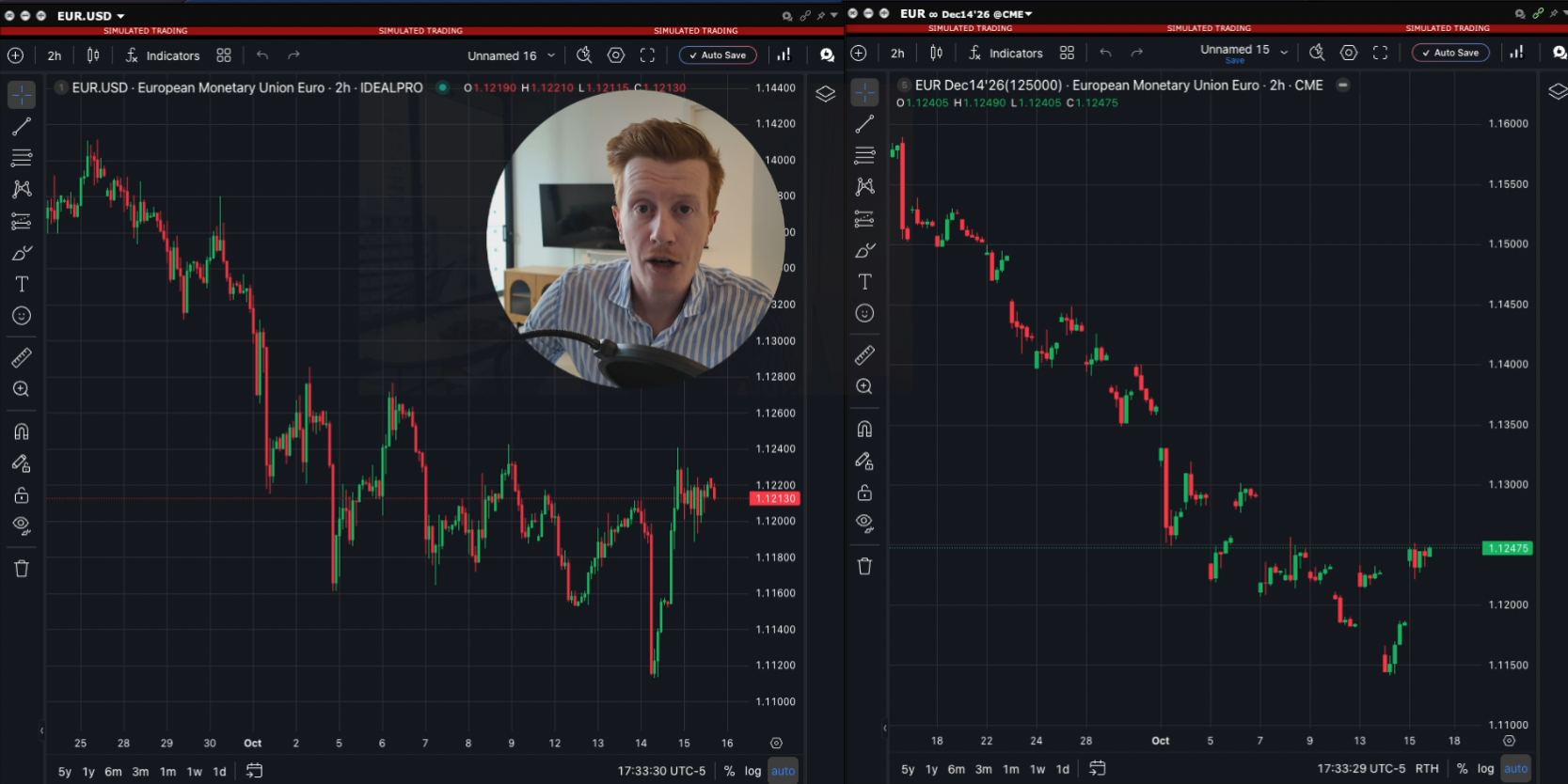
On Interactive Brokers on the day of the recording, EUR/USD spot was quoted around 1.1213 while the December 2026 EUR/USD future, expiring December 14, 2026, was quoted around 1.12475. The future trades above spot. Why?
ibkr-eurusd-spot-vs-future-december-2026
Because markets do not allow free arbitrage. If you want to lock in a currency exchange three months from now, you have two equivalent routes. You can buy the future. Or you can borrow dollars today, convert them into euros at spot, and invest those euros at the euro risk-free rate for three months while paying the dollar rate on your loan. For no arbitrage to exist, both routes must cost exactly the same. So the futures price has to embed the interest rate differential between the two currencies. That differential is called the carry.
The gap between the future and spot is called the forward points. The formula is: Future = Spot x (1 + r_quote x T) / (1 + r_base x T), where for EUR/USD the quote currency is the dollar, the base currency is the euro, and T is the time to expiry in years. Forward points are simply Future minus Spot. When dollar rates are higher than euro rates, as is the case today, the EUR/USD future trades above spot.
5. What the Hedge Really Costs (and When It Pays You)
In the Interactive Brokers example, the future traded about 35 pips above spot. For a European hedging dollar assets, that is a cost. You must buy the future, which is the more expensive of the two prices, to secure the spot rate at expiry. As expiry approaches, the futures price converges to spot. This is called basis convergence, and it is exactly how you pay the carry over the life of the contract.
With a rate differential between the euro area and the United States of about 1.4% today, giving back the forward points over time costs you roughly 1.4% per year of the hedged notional. Hedge 100,000 EUR and you pay around 1,400 EUR per year for the protection. For a European investor, the hedge has a modest but real cost.
For an American investor holding European assets, it is exactly the opposite: the hedge earns carry. More generally, if the ECB raised rates above dollar rates, a euro investor would be paid to hedge dollar exposure. The same formula applies to every currency pair. Take USD/JPY: the rate differential is heavily in favor of the dollar. That is the famous carry trade. Holding the right side of a futures position on that pair means collecting the forward points as positive carry.
6. Setting Up an FX Hedge on Interactive Brokers
For EUR/USD, I use the M6E contract, the micro EUR/USD future. Contract sizes matter: the micro covers 12,500 EUR, while the standard Euro FX contract (6E) covers 125,000 EUR. Pick the one that matches your notional and compute how many contracts you need. Liquidity on the euro is good, so the hedge can be put on instantly at market.
In the live demo I bought one M6E contract, which amounts to exchanging forward about 14,050 USD against 12,500 EUR. From that point, roughly 14,000 USD of my dollar exposure is protected against EUR/USD moves. I no longer carry currency risk on that slice of the portfolio.
Check the contract details before anything else. Here, the last trading date is December 14 at 9:16 AM. That date drives your whole operational calendar: you must roll before it, not on it.
7. Rolling the Future Before Expiry
A couple of days before the last trading date, around December 12 in this case, you roll the hedge. On Interactive Brokers, open the futures spread for M6E: the front leg is December, the next leg is March 2027. Select that calendar spread and the platform quotes the roll price directly.
In the demo the roll cost 44 pips. That figure is the carry you pay for the next three months of protection, consistent with the rate differential. Because the spread is very liquid, I send it at market. Buying the spread sells the December contract you already hold and buys the March contract in a single order. After execution, the December position is back to zero and the March position is open. The hedge continues without any gap.
Forget this step and the contract runs to expiry. Currency futures on CME are physically settled, and your broker will either force-liquidate the position or leave you facing delivery. Either way, your hedge disappears at the worst moment. Put the roll dates in your calendar, every quarter.
8. Margin Calls and Operational Discipline
Futures are margined daily. If you hedge as shown here and the euro falls sharply, your long EUR/USD future loses value and Interactive Brokers will call for dollars. Your dollar cash balance can go negative, and you are back to paying the broker financing spread you wanted to avoid. Keep a small dollar buffer in the account to absorb variation margin.
On paper the method looks simple. In practice it is a process: size the hedge, monitor portfolio value, adjust the number of contracts, roll every quarter, keep a margin buffer. None of it is hard, but skipping any step breaks the hedge.
Beyond hedging, currency futures open a whole set of strategies: carry trades, relative value between currency pairs, calendar spreads. If you want to dig into how futures work in depth, I recommend a reference book on futures and options pricing, and in the video I share my Interactive Brokers watchlist of all available currency futures, more or less liquid depending on the pair. And if you want to hedge part of your portfolio but are afraid of getting it wrong, you can book a one-hour coaching session with me.
Should I always hedge 100% of my dollar exposure?
Not necessarily. For a long-only S&P 500 holder, the dollar has historically acted as a partial cushion in crashes, so some investors keep part of the exposure. For market neutral or systematic strategies, FX risk is pure noise on top of your edge, and a full hedge usually makes sense. The ratio is your call, the method is the same.
Why use futures instead of just keeping a negative dollar balance?
A negative dollar balance is charged at the market rate plus the broker spread, often 1% per year or more on top. A future embeds only the market interest rate differential. On a portfolio targeting a few percent of return, that spread difference is significant.
How many M6E contracts do I need?
Divide the euro value of your dollar exposure by 12,500 EUR and round to the nearest contract. For example, about 50,000 EUR of dollar assets needs 4 micro contracts. Recheck the ratio regularly as your portfolio grows or shrinks, since the contract size never changes.
What happens if I forget to roll?
The contract goes to expiry. CME currency futures are physically settled, so your broker will typically close the position for you near expiry or you may face delivery. In both cases your hedge stops, so set a recurring reminder a couple of days before each last trading date.
Does the hedge cost always stay at 1.4% per year?
No. The cost tracks the interest rate differential between the two currencies. If the gap between dollar and euro rates narrows, the cost falls, and if euro rates moved above dollar rates, a euro investor would earn carry by hedging instead of paying it.